Wednesday, 3 November 2010

My chat with the Secretary of Energy

Yesterday I went to LASERFest at the Glasgow Science Centre. This symposium was put together to celebrate 50 years of the LASER and featured some big names in the LASER community (although all capitals is technically correct, typing it that way is irritating me, so I'm going to "laser", sorry pendants) including three Nobel Prize winners. The opening, keynote speaker was the United States Secretary of Energy, Dr Steven Chu. This guy:
He just looks cool, doesn't he? Anyway, he is pretty much a genius and gave a great talk on his research with lasers with applications for physics as well as biology. He is an engaging speaker as well. After an intense talk, he posed the question, "Why would someone like me leave science to be the director of a DOE lab or a government position?" Answer: Climate change. He gave a brief discussion on why he thinks climate change needs to be discussed and some talking points on how to sell the concept to the public.

It is less of a hard sell in the UK, but in America, it still takes a lot of convincing to get people to even trust a scientist. Scientists are generally seen as heathen, non-believer know-it-alls who are telling god's children how to live their lives, and god wouldn't like that, would he? Even someone as awesome as this:
can't manage to convince the public, then it is a pretty hard sell!

Anyway, Dr Chu made some interesting comments, like how he is not 100% sure of the cause or the effect of climate change, but he is well more than 50% sure, and that should be enough to at least want to try something. He also commented that in response to people who say that we should "wait and see" when it comes to climate change do not understand that it takes approximately 100 years for the deep oceans to come to equilibrium with the surface. This means that whatever we have done on the surface will not have an effect on the world-wide environs for 10 decades.

Dr Chu said that the Department of Energy is funding a new initiative called ARPA-E which invests in short-term cockamamie ventures to solve the energy crisis. Dr Chu made the point of saying that most will fail, but if one in 30 is "okay" and one in 50 is a success, then it is a worthwhile investment. I think that this is a good investment, particularly for short-term and honestly, we need more support for "cockamamie" theories as the best scientific discoveries have come from this.

After his talk, I got a chance to speak with him in person. I asked him what the DoE is doing to make their current investments sustainable (see how I used that word there?) to last beyond one 2-year government (one that has just ended today). What frightens me is that there are some great things that are being done in this government, but as soon as a new one takes over (at any level) they can begin reversing great ideas (Kyoto Protocol anyone?)
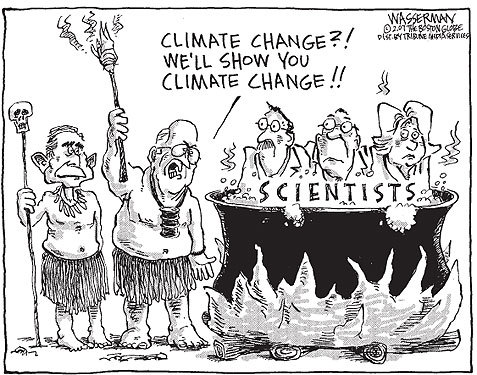

To be fair, this was not a very polite question to ask him, as it was not the reason he was there, but I was curious and I had a chance to ask. Why not? He answered in a politicians sort of way, with an answer that I accept, but am not happy about. He said that he believes to make the future sustainable we need to educate children; that children are the ones who got their parents to wear seatbelts and children got their parents to quit smoking, so children have the power to teach their parents to be responsible to the environment. Logically, I asked if the DoE was funding any outreach projects or working towards communicating with children. Dr Chu responded with a polite, but conversation-ending "No." Fair enough. 

We need to be investing in communicating with children. I spent the next talk trying to imagine ways to implement this myself, and making a pledge to my own future that I would be more proactive in trying to communicate science to children. The rhetoric surrounding climate change needs to be modified. Some people are sick of hearing about it, but maybe that is because we see little progress. Anti-progressives rudely comment on science and the people behind the science. The thing that irritates me the most about the Bush Administration is that it touted being ignorant as being acceptable. That the intelligent people in the world were the elite snobs who are trying to tell you how to live your life. I could devote an entire post to my frustration, but here is not the place. I will save that for another day. Instead, I will simply do this:

I appreciate Dr Chu taking his time to speak with me and I hope he tries to do what he can to educate the children of not just America, but the world.

Dr Chu ended his talk with this Native American saying and I will, too, cliché and repeated advice aside: "Treat the Earth well. It was not given to you by your parents; it was loaned to you by your children"

Tuesday, 26 October 2010

That time of year...

I'm going to go a bit non-science on you now, so bear with me.

I love autumn. I love it so much. The smell in the air, the colours of the trees, the cold slowly sneaking in, it's all a wonderful experience. Also, it's Halloween season! Since I was a kid, I loved dressing up as all the people I wish I was or thought I would be. If you look at my costumes of choice as a child, you'd find a pretty weird kid. The one's with the highest frequency were Princess Leia and Cruella DeVil. There was also one disastrous occasion when I was twelve and thought I was cool and bad-ass enough to pull of Dana Scully. Also, an award-winning (at the University of New Mexico) costume as Winnie from Hocus Pocus that brought back some nostalgia for my peers:

(yes, that's my own hair. I don't think my hair ever forgave me)

During my teenage and university years, I was always the one hosting (and sometimes forcing) Halloween parties on people, finally giving up when no one would get into it and I was the only damned fool sitting around in a stupid costume. Now I finally live somewhere where my friends host their own parties and everyone does get dressed up. I do love it, except for that awkward first hour where no one has had enough alcohol to feel comfortable to wander around wearing a box or some elaborate facepaint.

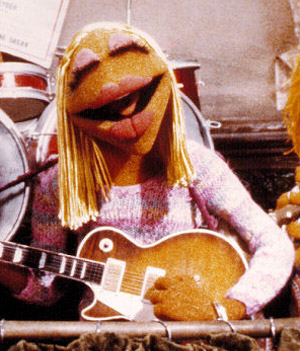
This year, the theme is Muppets and this is my character:

I'll see how the costume turns out before I post any pictures. My brother suggested I just get really high and then I'll magically transform. I'm going to attempt the legal approach, which may back-fire, but we'll see. Last year I was in a very bad mood for the party, so hopefully this year it will be better.

On to notes of a more personal nature, though you are welcome to read as this is nothing I wouldn't say to anyone sitting with me in a pub. Thanks to events transpiring a few years ago now, I also am doomed to feel a bit melancholy this time of year. I am holding out hope that this does not last the rest of my life, but that may be a bit out of my hands. Last year, one of my best friends and I performed in the CU drag show:
Yes, that is me. Anyway, it was a great night, but through my friend (the one on the right, who is actually a man) I met someone who ended up changing my life forever. I really wanted to make it work, but timing was against us; a PhD opportunity came up and our own lives prevented us from staying together. I fought long and hard to keep us together and through some surprising turn of events and some misleading behaviour, I ended up getting kicked to the kerb, quite surprisingly and violently.

I still feel like I am down there, trying to desperately climb out, but the walls are high and slippery. Friends help, but ultimately it will only be the feeling of love that will get me back out of there. Every once in a while, an opportunity arises, but I think these men quickly realise that it takes some effort to help me out and feel that I am not worth the time or the risk, only making it harder for me to climb out myself. I hold out hope that one day someone will want to take the risk. I feel like the culture I am in is not a risky one, where people stay with someone or something because it is safe. I am not a safe person and that scares people, it seems like. I stand up for myself, let my personality shine and am not afraid to be myself. It is working against me. People, however, are not afraid to say that I am too much work, that it would be easier for them to stay with their routine (be it a former or current relationship, or their single life) even though it may not be as great as they wish, instead of taking the risk with me. Oh well, it will happen one day.

I know this is fairly personal, but there is not much of an outlet for me. People also need to know to stop telling me that "I'm young and I have plenty of time to meet someone." I'm sorry, but fuck off. I do not care how old I am; all I know is that I was in love, was loved and helped care for a kid. That matured me way beyond most people I know. That's all I want to have again. The bottom line is, though, that he did not see me as "worth fighting for" through my PhD, and I have to keep reminding myself of that. I hope him and his daughter are well, though I still cannot handle hearing about how he is doing and he made it pretty clear he did not want to hear from me. He is a non-entity to preserve my sanity.

So goes life, I guess, but this is kick-starting a holiday season that will be a pretty painful one. Hopefully the presence of one of my best friends will help. I am planning lots of alcohol.

All that being said, bring on the pain, for it is what makes us human. Thanks for reading!


Science next time, I promise... ;-)

Tuesday, 19 October 2010

Faces of Science - A Call to Action

Thank you all for the amazing support and encouragement with this project. I have received some fantastic emails and comments in the last few days. It is a great feeling to see a project come to fruition.

After some thought, I believe I will take this project in two directions. First, a sort of mini-expose on young scientists that can be shared on this blog. Every so often, I will highlight a young (or young-at-heart) scientist at whatever point in their career with what their life is like. So this is a solicitation to all you amazing and interesting people to share your story with me. Please comment, twitter, email or send up smoke signals letting me know you would be happy to put a mini-bio of yourself on the website. We can do a questionnaire, get some photos and some good stories and share your life and experience as a scientist to the world. We want the rest of society to know we are real people with awesome hobbies, families, adventures and personalities.

I particularly want this to be as real as possible, so even if you think you don't qualify because you are not a professional hockey player on the side (I'm not sure how that would work) or if your blog on heavy metal music only reaches 2-3 people a week, tell me about it! Tell me about wanting to be a scientist as a kid (or if you didn't, how did you end up here?). Who did you idolise? Did you have a poster of Uhura up in your bedroom until you were 28? Is your significant other a scientist? How did you meet? What do you listen to while you do research? Do the lyrics from Paradise City somehow find their way into your code? (Oh, just me then? Okay.) You get the idea. So please, get in touch!

Now, the second aspect to this project is a bit more ambitious, but there seems to be a lot of support and resources for this. I would like to do a photography exhibition along the same lines. I would like to show the faces behind the science, from the past to the present (and twirling...twirling into the future!). This is obviously much more long term, but I would also like opinions and suggestions for this. I think it would be interesting to have some non-science information about famous figures; what were their spouses like? Did they go to social events? Did they like music? Obviously, the further back we go, the harder this information is to obtain, but it could be a journey through history, showing the diverse backgrounds of scientists. It is important to convey to the public that us scientists come from all sorts of histories and specialities, through time. It would be especially effective if through the exhibit, the stories and the diversity exploded as we got closer to 'modern' times. It could have great potential to really inspire kids that anyone could be a scientist.

You know how parents sometimes tell their kids that "Einstein wasn't very good at maths at school either" [which isn't true, but you know what I mean] to try to encourage them to stick with it? Well, wouldn't it be much more effective if there was a widely-held belief that, actually, most scientists struggle at first, and it does not come easy to all of us, but if you like it and you want to do it, you should be able to. Kids want to be rock stars and presidents, why can't being a scientist seem just as cool and easy? After all, it's the motivation that got us all started, right?


Scientists would have much more of a priority in politics and government if funding was not seen as a burdensome obligation, but instead as an easy way to secure the future of the country and the prospects of future generations. Imagine if, instead of the one geeky kid (probably you or me or whoever else is reading this) who sheepishly says they kind of want to be a scientist when they grow up, most kids were able to say this proudly and without hesitation. If it was given the same regard and respect as politicians or musicians, we could really change the world.

Bring it on!
________________
New website for The Faces of Science: http://facesofscience.blogspot.com/ Enjoy!

Saturday, 16 October 2010

Time Travel or Universe Travel?

Lately my mind has been drifting to the thoughts of time travel. In this week alone, I went and saw Back to the Future in the cinema and I got the majority of my new tattoo finished.

Behold!!
Now, one can only hope that when we discover the time vortex, it is that pretty and colourful and shiny.


So, thinking about time travel, in my opinion, it goes something along the lines of having billions and billions of parallel universes. Time travel is not so much the travel along a linear time path, but a jump into a timeline of a different universe. For example, in Back to the Future when Marty goes into 1955 and ploughs down one of the "Twin Pines" with his Delorean, he changes the future of the shopping mall to "Lone Pine". However, he has entered a new universe. The universe where Marty left continues on, with two pines and a wimp of a father, but without Marty. The parallel universe that the Marty we are following enters, has previously been occupied with a different Marty who disappeared to a new universe when he took off in the Delorean the same way our Marty did. Okay, this gets a bit confusing. Let's try a new one.


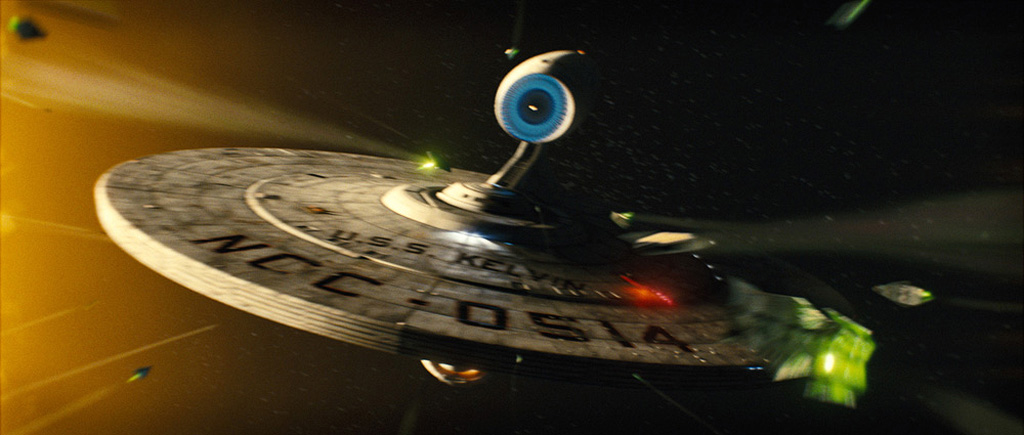
So, take Star Trek. Now aside from the brilliant, innovative science behind "red matter" (ha ha) the time travel is quite interesting. We have all happily followed along the adventures of Kirk, Spock, Uhura, Scotty and the other members of The Enterprise with (occasionally) silent devotion. As the timeline continued, with the stories we knew, at one point the Romulan planet gets annihilated in a supernova. Spock and the Romulans travel through a black hole "back in time" (i.e. to another universe) and pop out at the location of the USS Kelvin, starting off the plot of the new Star Trek world. We are now in a new universe where new adventures with the usual gang can take place. The original stories that we all know are still in tact, but in a different universe.


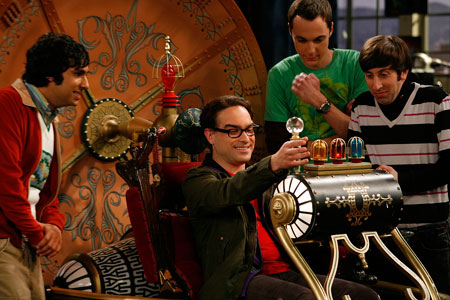
One last example, in The Big Bang Theory Sheldon postulates that if he invents a time machine, he will go back to himself and inform him of the invention, thus relieving Sheldon of ever having to invent it. However, the Sheldon in that universe would have to still invent the time machine; it is the Sheldon in the new universe that will be spared the invention.

These are the things I ponder when trying to fall asleep. It isn't perfect, but it is sure fun to think about. What are your thoughts? How do you think of time travel? Bring it on!

On a side note, Back to the Future was AWESOME in the theatre!

Monday, 11 October 2010

The Faces of Science - A new project

Yes, I know it has been ages. Yes, you can stop telling me now. No, I haven't died nor have I (really) given it up. I have been spending some time thinking about what I would like to do and where I would like to take my career, having been asked it (randomly) by a few people recently. Ideally, I would love to do outreach and communicate science to the general public, as this blog was initially started, but I have found that journalism is not necessarily the route I want. I desire communication through media apart from blogs as in television, photography or public speaking. So one question remains, what is stopping me? Well, I'll tell you:
1. my PhD research, for now. It is just difficult enough to maintain the motivation and drive for a PhD without worrying about too many side projects.
2. making the contacts and developing the resources for projects I want to do. I am just simply too early in my career for the necessary access to the wider community
3. A lack of creativity. Every once in a while I get inspired, but then 1 and 2 stop me in my tracks... I find it difficult to pursue certain ideas
4. laziness. Yes, I can admit it. 1 and 2 should not really stop me.
5. Fear of mockery and intimidation from the wider scientific field. I am a lowly PhD student; how do I know what I am talking about?

All of that being said, here is where I see the gap in scientific outreach. There are many highly skilled individuals successfully communicating complex scientific concepts to the general public, but there is still not a face to these scientists. I was pondering the success of the show,The Big Bang Theory. Most of my science friends are astonished that our non-science partners, friends and family find the show as entertaining as we do. We laugh because we are those people, but there's a certain appeal, I believe, from the wider public to glimpse into the life of the ever-elusive scientist. What do we do? What do we talk about? Do we date? What is dating like? What are our friendships like? Do we have a soul? This has resonated with the public through a fictional situation comedy. So why can't we tell those stories ourselves? Why can't the public see that scientists are just as unique, creative and passionate as the rest of the world?

Is it possible that if the rest of the world had a more human face to the work of scientists, we would be more successful in procuring government funding and public support?

As a PhD student who has moved from America to work in the UK, funding and support from government is vital in me wanting to live where I want and being able to do the work I want. Science already has an international community, but when governments do not support this venture, it becomes difficult for us to do the work necessary to maintain these ties.

Two thoughts popped into my mind for this project, both ambitious and currently suffering a severe lack of resources. First, I thought a photography campaign showing the lives of scientists, their individuality, the dynamics of a research group would be interesting. This could be shown to the public via magazine, photography exhibits or other means (I am clearly not a photographer). Another would be a documentary of sorts, with interviews and stories of real scientists, young and old, and the way they see the world, through their personal life, not just through their research.

What do you think? Is this a feasible project? Do you have any ideas? Would you like to work with me?

Thursday, 19 August 2010

* sigh *

So, yes, I know it's been a while, and I have sort of dropped the ball on this, but I am sick of writing about science. I see it every day, I talk about it every day, I think about it every day, I don't want to write about it every day. Such is the life I guess. I have found much more entertaining ways to spend my evenings and my artistic ability.

I am currently working in Germany for a few weeks to run my project past people here. Here are some things I've discovered:

1. I am a crap programmer, but I have potential, but that criticism and process makes me stressed out.

2. I get very stressed out when I do not speak a language

3. I am a stress-eater. I eat when I am stressed. A lot. Apparently I have not been stressed out for a long time. Last night, when I discovered that I was eating obsessively, did I recall the last time I must have been this level of stressed, during exams at CU when I did not have a boyfriend with whom I could ahem "work the stress out" or at the very least, bitch at for an hour and then play poker over drinks... you know, company helps stress. So we're talking a few years here. However, that came back last night. I ate all the food I bought for a week. All the food. In 2 days. I am sticking with the multiple cheap takeaways for the rest of my time here. It was absurd. I knew I was full, but all I wanted to do was eat. At least I know I am not an eater for loneliness or depression... just stress. And company (for me) takes the stress away. Ah well, it shall be solved.

4. When I am stressed I am very tired. When I am very tired, I still make myself get up at my usual time. When I am tired and up at my usual time I forget to wash the conditioner out of my hair in the shower.... .... .... yeah.

* sigh *

I wish I owned Dr Who DVDs. I am going to buy them when I get home. Maybe I'll try to find them here. The Doctor fills my lack-of-companion void. Which as I said before, hasn't usually been a problem, but it very much is a problem when I am stressed out.

Oh and my face is breaking out for the following reasons:
1. I am stressed about not speaking the language

2. I do not know how to ask if things have dairy in them and if I did know, I really really don't want to be that annoying, particular, American tourist who doesn't speak the language, can barely try and needs all these little things taken care of. So I have been eating a lot (read: any) dairy resulting in my face erupting like Krakatoa and my skin feeling like it's on fire. I am sticking with sausages and Chinese take-away.

Somehow I think it's easier for non-Americans to not speak German. I feel like there is this international stigma against American tourists. I've been met with it my whole life and spent my whole life trying to work away from it. However, no matter how polite I am or how soft-spoken I am (or try to be) as soon as I open my mouth, people's brains go "AHHH AMERICAN!!" and mentally run away screaming, reliving the horror they have had in the past with Hawaiian-shirt-wearing, loud, ignorant, picky, whiny Americans. It is very very very difficult to work yourself out of this box. I feel like I have only just begun to do that in Scotland, but I am set back well over a year being here. It feels terrible. I really hate that box and I hate being thrown in that box when I open my mouth. That box has high, slippery walls.

Thursday, 22 July 2010

Your R136a1 is so fat...

Any regular news readers would have been hard-pressed to miss the news that the largest star to date has been discovered, our new friend, R136a1. Using the ESO Very Large Telescope and archival Hubble data, researchers at the University of Sheffield isolated a star that is 265 times the mass of the Sun, a million times brighter and a birthweight about 320 times the Sun's.

Paul Crowther, Professor of Astrophysics at the University of Sheffield studied two young clusters of stars, NGC 3603 and RMC 136a, both clusters of young, hot, massive stars. The interesting thing about this is that this discovery completely dwarfs previous knowledge that stars were limited in their mass by about 150 times the mass of the Sun. Within R136, only four stars weighed more than 150 solar masses at birth, yet they account for nearly half of the wind and radiation power of the entire cluster, comprising approximately 100 000 stars in total.


Comparing R1361a to the Sun, the brightness is about the difference between the Sun and the full moon. Imagine now that we simply replaced the Sun with R136a1, “Its high mass would reduce the length of the Earth's year to three weeks, and it would bathe the Earth in incredibly intense ultraviolet radiation, rendering life on our planet impossible,” says team-member Raphael Hirschi from Keele University.The relative sizes of different stellar classifications are shown below:


The important thing to take away from this discovery is that this is simply the dynamics of scientific research. In the same way the Kuiper Belt forced us to redefine our Solar System and Pluto's classification, this forces us to redefine our understanding of stellar evolution and dynamics. I am inclined to agree with astronomer royal Martin Rees (who can't? With such stellar *ahem* eyes and a devil-may-care smirk...) in his assessment that this is a cool discovery and it's great that it involves UK science and advanced telescopes, but it is not Earth-shattering. It just makes us appreciate the ever-changing understanding of the universe around us.